Posts

Showing posts with the label photograph

Birds and Bugs... the Red-Browed Finch

Image
Also known as the red-browed firetail, these little guys were incredibly hard to photograph. In the end, I had to be satisfied with pictures that also had sparrows. We've put wild bird mix in the feeder, which they all seem to enjoy. These shots were taken in early November 2015. Just so you know, this is NOT a red-browed finch - although there is one in the background; the bird in front is a young female sparrow. The two of them seem to share quite well, and you can just see the red-brows for which the finch is named. He looks even better, on his own. And doesn't seem to mind the camera at all. The sparrow returns, but the finch is not intimidated. You can see the red markings on his rump that give him the name 'red-browed firetail'. The two dine quite companionably, and the finch turns a little more so we can get a better look at the tail markings. Here's another angle showing his face mask and beak. And then he turns...
Birds and Bugs... And Butterflies

Image
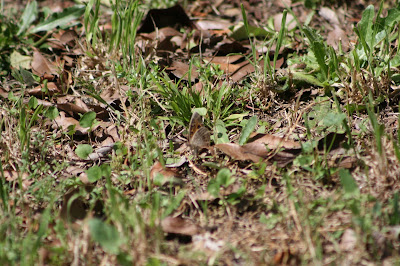
It's late spring in Australia - the last month of spring, to be exact, so I thought I'd share a couple of butterflies that came to visit. At first glance, they don't look like much... and they're fairly well camoflauged. And then they start to open their wings, and we see a flash of promise. If we shift the angle, just a little bit... We saw more of the colour hidden inside And then a little more... Until the butterfly reveals its true colours...  ...and then it flies away.

Spiders in my House - May 2015

Image
This not-so-little lady was roaming around the house. She was low enough on the wall that I almost walked into her, but she wasn't aggressive and I caught her in the plastic container you see there, using a piece of thick cardboard to close the top. The trick is not to put your hand on the base of the container above the spider, where it will look like a predator about to strike. That causes the spider to panic. This one, we put outside to make her own way. She'll be around somewhere if one of the other spiders didn't eat her.

Australian Birds: Cattle Egret (Ardea ibis)

Image
This white egret was biding his time by the edge of a small local lake, when a white-faced heron flew past.  Once it had gone, the egret continued to contemplate the water, in peace.  To find out more about the Australian cattle egret, you can visit the following sites: http://www.birdsinbackyards.net/species/Ardea-ibis ; http://www.environment.gov.au/cgi-bin/sprat/public/publicspecies.pl?taxon_id=1000 ; http://en.wikipedia.org/wiki/Cattle_egret ; http://www.parks.tas.gov.au/index.aspx?base=19294 ; http://australianmuseum.net.au/Cattle-Egret ; http://www.graemechapman.com.au/library/viewphotos.php?c=128 .

Australian Birds: White-Faced Heron (Egretta novaehollandiae)

Image
An early morning walk helps you find so many things. I first saw this white-faced heron wading down a culvert at dusk. This time, I saw it by a small lake: And then it flew past a cattle egret on the way to new fishing grounds.  Where it settled down enough to allow me some zoomed-in shots. You can find out more about the white-faced heron at the following sites: http://www.birdsinbackyards.net/species/Egretta-novaehollandiae; http://en.wikipedia.org/wiki/White-faced_heron; http://birdlife.org.au/bird-profile/white-faced-heron; http://www.arkive.org/white-faced-heron/egretta-novaehollandiae/; http://www.wildlifewalkabout.com/profiles.htm; http://www.parks.tas.gov.au/?base=17061.

Australian Birds: Superb Parrot (Polytelis swainsonii)

Image
On a grey morning, I went out to look for birds. I didn't have a lot of luck, but I did spot these beauties coming in to land on this tree. I'd noticed them on other walks, on the ground, but this particular morning, they did not oblige by coming out of the tree. The first shot shows where they landed.  The next few shots catch show a glimpse of yellow and red. But it wasn't until this one turned side on, that I had enough to be able to identify them. I'm thinking the males have yellow faces.  And the females or juveniles are all green... maybe. Apparently, the superb parrot is a threatened species, so I feel particularly lucky to have been able to photograph these. More information on superb parrots can be found at the following sites: http://www.birdsinbackyards.net/species/Polytelis-swainsonii ; http://en.wikipedia.org/wiki/Superb_parrot ; http://www.environment.nsw.gov.au/threatenedspeciesapp/profile.aspx?id=10645 ; http:/...

Australian Birds: Crimson Rosella (Platycercus elegans)

Image
So, I went for a bit of a walk, trying to get some different shots of the crimson rosellas. At first they proved to be very elusive, and they stayed that way for the morning. This was the only shot I had of a pair in a tree. For bright red and blue (and green) birds, they can be quite difficult to see, when they are feeding in long grass.  Harder still when they bend down to feed. There are two birds in each of the shots below.  And there they are again. If even red and blue birds can hide in the long grass, what chance do we have against velociraptors? You can find more about crimson lorikeets from the following sites: http://www.birdsinbackyards.net/species/Platycercus-elegans ; http://en.wikipedia.org/wiki/Crimson_rosella ; http://birds.about.com/od/mediumbirds/p/Crimson-Rosellas-As-Pets.htm ; http://parkweb.vic.gov.au/__data/assets/pdf_file/0012/322203/rosella4.pdf ; http://australianmuseum.net.au/Crimson-Rosella ...

Australian Birds—Soggy Magpies (Cracticus tibicen)

Image
I know I've written about magpies before, but I couldn't resist taking a few shots of some very wobegone-looking birds who came to visit on a very wet Saturday morning in August, this year. They looked much happier once the rain had stopped. For more information on Magpies, check out: https://www.youtube.com/watch?v=4858bWD-DPU http://en.wikipedia.org/wiki/Magpie http://en.wikipedia.org/wiki/Australian_magpie http://www.birdsinbackyards.net/species/Cracticus-tibicen http://www.environment.nsw.gov.au/animals/TheAustralianMagpie.htm http://www.climatewatch.org.au/species/birds/australian-magpie

Introduced Insect—The Honeybee

Image
While I was busy chasing wattlebirds and silver-eyed wrens, I noticed that the bees also liked the cherry blossoms - and who could blame them. Here are a few shots taken with the close-up lens (as I don't own a macro). It was a beautiful day in the last fortnight of winter, and the bees were enjoying the blossoms and the sunshine. I didn't know they liked cherry blossoms, quite this much, but they hummed busily around, stopping to investigate each bloom thoroughly, completely ignoring the camera as they did so, although, I;m sure they were aware of me.

Australian Birds: Spur-Wing Plovers or Masked Lapwings (Vanellus miles)

Image
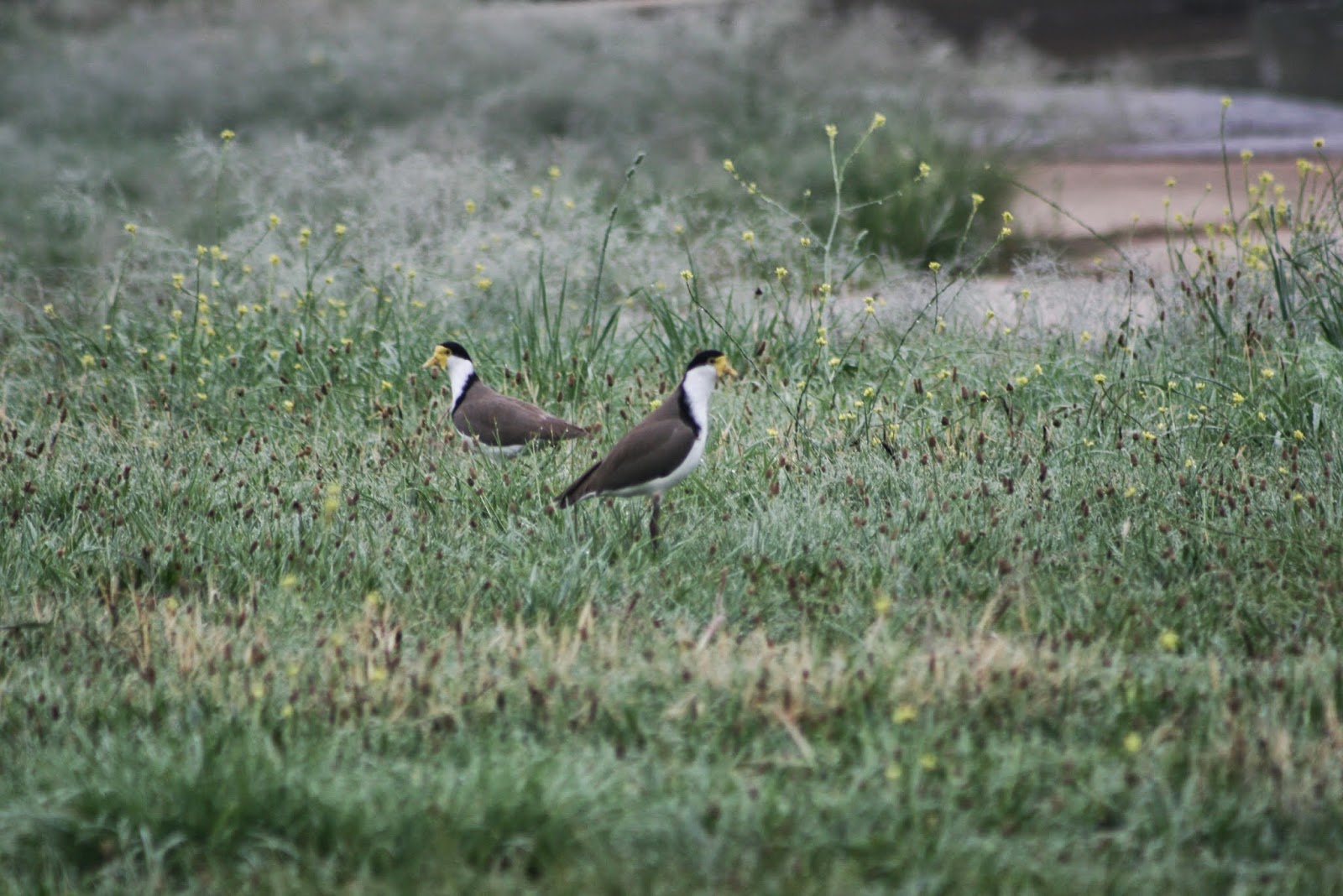
These guys are pretty paranoid and very noisy when disturbed, making a kind of 'kak-kak-kak' sound. As you can see, they're very watchful. These ones don't like having their pictures taken and moved rapidly away from the camera. You can find out more information about spur-wing plovers at the following sites: http://en.wikipedia.org/wiki/Spur-winged_Lapwing http://en.wikipedia.org/wiki/Masked_Lapwing http://www.mdavid.com.au/birds/maskedlapwings.shtml http://australianmuseum.net.au/Masked-Lapwing/